30 Magical DnD Trivia Questions and Answers
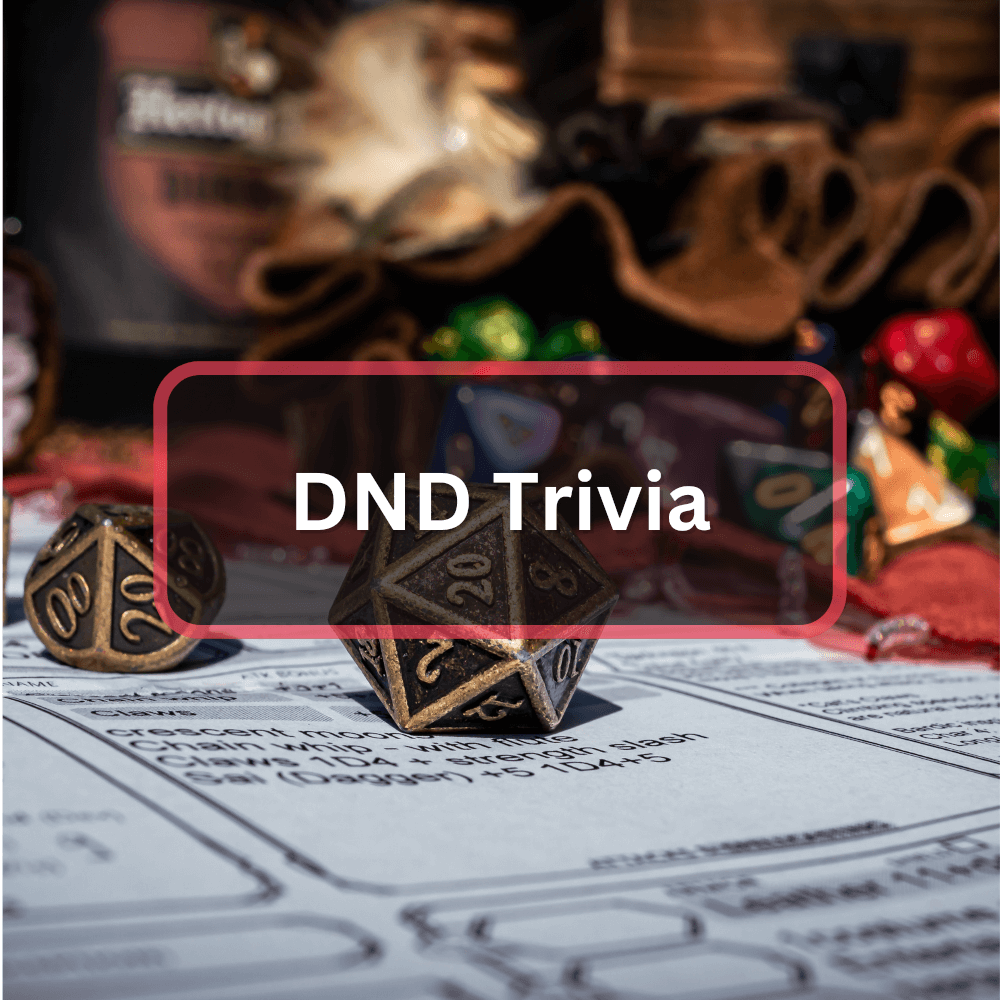
Roll for initiative with D&D Trivia! From the origins of the world’s most famous tabletop role-playing game to iconic monsters, legendary campaigns, and pop culture appearances, these questions will test how well you know Dungeons & Dragons. Perfect for dungeon masters, players, or anyone fascinated by fantasy adventures, this trivia dives into the rules, lore, and legacy of D&D.
1In what year was the original Dungeons & Dragons boxed set first published?
2Who are officially credited as the co-creators of Dungeons & Dragons?
3Which company acquired TSR, the original publisher of DnD, in 1997?
4What was the first hardcover DnD book, and when was it published?
5What does “THAC0” stand for in AD&D-era rules?
6In which edition did DnD switch from descending to ascending Armor Class as the core system?
7What 1975 supplement introduced the beholder and helped cement it as a DnD-original monster?
8Which iconic dungeon module began as a tournament adventure at Origins 1975 before TSR published it?
9What is widely cited as the first published D&D adventure scenario (appearing inside a rules supplement in 1975)?
10Which DnD campaign setting debuted as a boxed set in 1987 from Ed Greenwood and Jeff Grubb?
11What classic 1983 ADnD module introduced Strahd von Zarovich and inspired a long-running gothic setting?
12What is “Appendix N” and where did it first appear?
13From which authors did Gary Gygax say the alignment system drew major inspiration?
14When did the Dungeons & Dragons Saturday-morning animated television series first air?
15What famed DnD-original ooze was designed as a perfect 10×10×10-foot “corridor cleaner”?
16What artifact-bearing lich has a name that’s an anagram tribute to author Jack Vance?
17Which magazine evolved from The Strategic Review and became one of D&D’s two official periodicals in 1976?
18What was the first ADnD core rulebook to be released—preceding the Player’s Handbook and DMG?
19Which edition (and year) launched alongside the d20 System and the Open Game License that opened DnD mechanics to third parties?
20What licensing change did Wizards announce in January 2023 regarding SRD 5.1?
21Which OD&D/AD&D-era controversies led TSR to rename “demons” and “devils” in 2e?
22In 2014, what digital rules release preceded the 5e Player’s Handbook?
23Which adventure path of the late 1970s first gave the drow full game statistics and lore?
24Which in-universe “eye tyrant” species is explicitly held back by Wizards as Product Identity (not OGL)?
25What open playtest initiative beginning in 2012 gathered massive feedback for the next edition (5e)?
26Which years did 5e see especially strong sales growth, according to contemporary reporting?
27Which cultural phenomenon is credited with boosting mainstream interest in DnD during the 2010s?
28What 2024-era update to 5e (sometimes called the 2024 revision) keeps compatibility while revising core rules and terminology?
29What early DnD periodical preceded Dragon magazine and ran in 1975–76?
30Which System Reference Document release in 2025 expanded Creative Commons access to the updated rules?
Answer Key
- 1. 1974
- 2. Gary Gygax and Dave Arneson
- 3. Wizards of the Coast
- 4. The Monster Manual (AD&D), December 1977
- 5. “To Hit Armor Class 0”
- 6. Third Edition (2000)
- 7. Supplement I: Greyhawk (1975)
- 8. Tomb of Horrors (S1)
- 9. Temple of the Frog (in the Blackmoor supplement)
- 10. The Forgotten Realms Campaign Setting (1987)
- 11. I6 Ravenloft (1983)
- 12. A bibliography of inspirations in the AD&D Dungeon Master’s Guide (1979)
- 13. Michael Moorcock and Poul Anderson
- 14. 1983 (on CBS)
- 15. The Gelatinous Cube
- 16. Vecna
- 17. Dragon magazine (first issue June 1976)
- 18. The Monster Manual (1977)
- 19. Third Edition, 2000
- 20. They placed SRD 5.1 under Creative Commons (CC BY 4.0)
- 21. The 1980s moral panic over D&D
- 22. The free Basic Rules PDF (August 2014)
- 23. The G–D–Q series (e.g., G3/Hall of the Fire Giant King; D1–D3)
- 24. Beholders
- 25. The D&D Next Public Playtest (launched May 24, 2012)
- 26. 2017 and 2018
- 27. Stranger Things
- 28. The 2024 rules revision of 5e
- 29. The Strategic Review
- 30. SRD 5.2 (2024/2025 rollout under CC BY 4.0)