15 Fun Facts About Dogs
Fifteen genuinely checked facts about dogs — including the world record that was quietly taken back in 2024, and the famous smell statistic that nobody has actually measured.
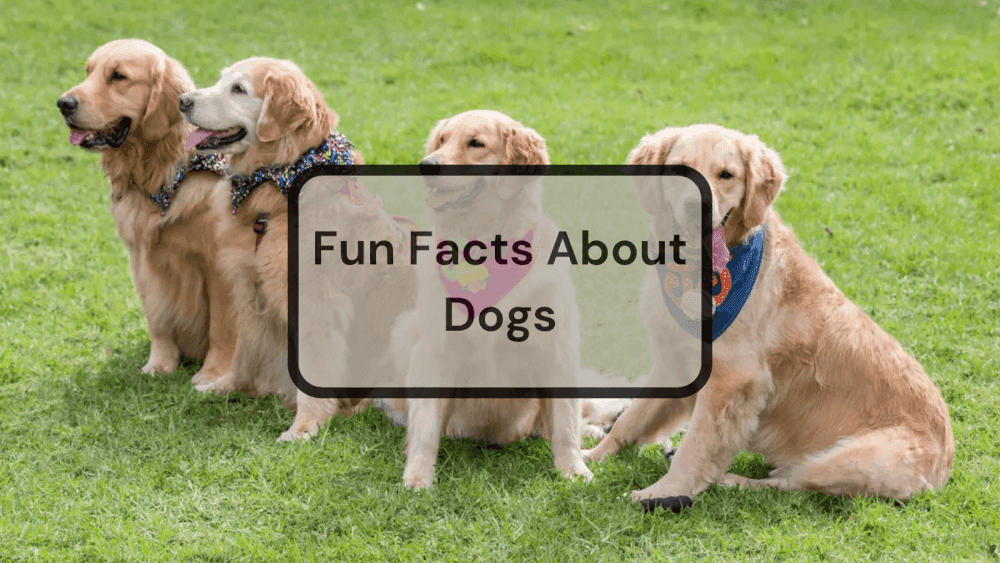
Most lists of dog facts are copies of other lists of dog facts. Somewhere back along that chain a number got rounded up, a world record went stale, and nobody went back to check. That is a shame, because the verified versions are usually stranger than the tidied-up ones.
So here are fifteen, checked. One of them is a correction.
The nose is the headline, and the famous number is slipperier than it looks
You have read that a dog's sense of smell is 10,000 to 100,000 times better than yours. That range is doing a lot of work. It is an estimate, it varies enormously by breed, and a spread of ten-thousand-fold between the low and high end is a clue that nobody has pinned it down precisely. A bloodhound and a pug are not running the same equipment.
The anatomy underneath is solid, though. A dog can carry up to around 300 million olfactory receptors. You have roughly six million. The part of the brain given over to analysing smell is proportionally about forty times larger than yours. Whatever the multiplier turns out to be, the gap is not close.
Two consequences follow. Every dog's nose print is unique, ridge for ridge, the way a fingerprint is — some registries use them as identification for lost or stolen dogs. And trained dogs can detect certain cancers, low blood sugar in diabetic patients, and COVID-19 infections, sometimes before a clinical test confirms it. They are not sensing illness in the abstract. They are smelling specific compounds that a sick body produces and a healthy one does not.
They sleep like us, which is why the twitching looks so familiar
Dogs go through REM sleep. That is the stage where dreaming happens in humans, and it comes with the same tell: paddling paws, flickering eyes, the occasional muffled bark at something you cannot see.
Puppies and elderly dogs do it more than dogs in their prime. The usual explanation is that young brains are consolidating an enormous amount of new information and old ones are working harder to hold onto it. Either way, if your puppy runs in its sleep, that is a brain filing the day away.
A wagging tail is a sentence, not a mood ring
This is the fact that changes how you read a dog on the street. Tail wagging is not a single signal meaning happy. Speed and direction both carry information.
A slow, hesitant wag usually means uncertainty — the dog is deciding about you. And the asymmetry is real and measurable: wags biased to the dog's right side are associated with positive feelings, wags biased to the left with anxiety or wariness. Other dogs read the difference and respond to it. Most people never notice there is a difference to read.
Built for one job each, and it shows
A greyhound can hit about 45 mph, which over a short sprint puts it ahead of a racehorse. It cannot hold that for long. It was never meant to — the breed is a sprinter shaped entirely around short, explosive chases.
Dogs barely sweat through their skin at all. They shed heat by panting and through the pads of their paws, which is why a hot pavement is a genuinely serious problem for a dog and merely an uncomfortable one for you.
The Basenji, a hunting breed from central Africa, does not bark. The shape of its larynx produces a yodelling sound instead, which owners call a barroo. It is not a quiet dog. It is a dog making an entirely different noise.
Puppies arrive blind and deaf, eyes and ear canals sealed for roughly the first two weeks, navigating by touch and smell alone. And Dalmatians are born completely white — the spots develop over the following weeks, so a Dalmatian puppy looks like a mistake until it suddenly does not.
The clever ones are cleverer than the claim suggests
You will see "dogs can learn over 1,000 words" quoted constantly. The specific dog behind that number deserves the credit: a border collie named Chaser, who learned the individual names of 1,022 toys and could retrieve any one of them on request. She could also work out which toy was new by elimination — shown an unfamiliar name, she picked the object she had never been asked for before.
That is a border collie raised on years of deliberate training, not a baseline for the species. Your dog probably knows a few dozen words and the precise sound of your car. Both are more impressive than they get credit for.
The bonding is chemical, too. Dogs release oxytocin when they interact with their owners, and so do the owners. It is the same hormone involved in human attachment, and it loops — the dog's levels rise, yours rise, and the mutual gaze that triggers it strengthens on both sides. Something like that turns out to be a feedback circuit.
About the oldest dog in the world
For a while the answer was Bobi, a Portuguese Rafeiro do Alentejo credited with 31 years and 165 days — a margin so far beyond normal canine lifespan that veterinarians started asking questions almost immediately.
Guinness World Records reviewed the claim after Bobi died, found the evidence inconclusive, and in February 2024 removed the record posthumously. The proof rested on a Portuguese pet database that did not require documentation of age for animals registered before 2008.
So the record reverted to where it had sat for most of a century: Bluey, an Australian cattle dog who died in 1939 at 29 years and 5 months. A dog from before the Second World War still holds it. That is the more interesting fact, and it is the one that almost every list still gets wrong.
Where to take this next
If you want to put any of this to use, our animal trivia questions cover the rest of the animal kingdom at length, and the nature trivia round goes wider still. The science trivia set is where the biology behind the nose and the oxytocin loop turns up in question form.
And if the greyhound speed figure appeals, the animals that genuinely should worry you are mostly in one country — the dangerous animals in Australia questions make that case fairly convincingly.
The through-line in all fifteen is that the checkable version is better than the version that gets copied around. A dog that yodels, a puppy that cannot see, a record held since 1939. None of it needed exaggerating in the first place.