State Flowers: All 50, and How the States Picked Them
All 50 state flowers from Alabama to Wyoming, and how they were chosen: by schoolchildren, by open ballot, by a 30-year lobbying campaign, and in Maine's case by not choosing a flower at all.
Maine's state flower is a pine cone. The legislature adopted the white pine cone and tassel in 1895, and nobody in Augusta has ever pretended it blooms. It's the most honest entry on a list full of compromises: flowers picked by schoolchildren and signed into law half a century later, one violet shared by four states, and an Oklahoma rose that took one woman three decades of lobbying.
Every state has one. How they got there is the better story, and it's the part most lists skip. The full A-to-Z list is further down. First, the patterns.
Chosen by schoolchildren, signed into law decades later
In November 1900, Mississippi schoolchildren voted overwhelmingly for the southern magnolia. The legislature didn't make it official until 1952. For half a century the state flower everybody in Mississippi knew had no law behind it at all.
Minnesota's first attempt went wrong. After an 1893 petition the state Senate named a lady's slipper, but the variety it named wasn't from Minnesota. In 1902 the women of the St. Anthony Study Circle pointed this out, and the Senate passed a new resolution for the pink and white lady's slipper, Cypripedium reginae. It went into the statute books in 1967.
Minnesota has also regulated picking and selling the flower since 1925, so the place to admire it is where it grows. Our Minnesota trivia questions have more on the state that undercounts its own lakes.
Montana skipped the committee and let everyone vote. In 1894 anyone could cast a ballot, whatever their age or gender; 5,857 came back, more than 32 flowers got votes, and the bitterroot won. It was a practical choice as well as a pretty one. Salish women dug its root, and a sack of the dried root could be traded for a horse.
The four-violet problem
State flowers repeat more than you'd guess. Illinois was the first of four states to choose the violet, picked by its schoolchildren in 1908, and New Jersey, Rhode Island and Wisconsin followed. The other doubles:
- Goldenrod: Kentucky and Nebraska, with Nebraska first in 1895.
- Southern magnolia: Louisiana and Mississippi.
- Flowering dogwood: North Carolina and Virginia, which made the dogwood its state tree as well.
- Mountain laurel: Connecticut, since 1907, and Pennsylvania.
- Apple blossom: Arkansas and Michigan.
- Wild prairie rose: Iowa and North Dakota.
Washington and West Virginia both chose a rhododendron, but not the same one. Washington's law insists on the native species, Rhododendron macrophyllum, a detail it wrote down in 1949 and again in 1959. West Virginia's is the great rhododendron, Rhododendron maximum.
That's why a state flower question can be harder than it looks: the obvious answer is often right for two states. Our state trivia questions lean on the symbols only one state has, and the Illinois trivia questions start with the violet.
The rule-breakers
Oklahoma had a floral emblem before it was a state: mistletoe, adopted by Oklahoma Territory in 1893. A plant that lives on trees stood in for a state flower for more than a century. The Oklahoma rose, a hybrid tea bred in 1964, finally took the title in 2004, after Dottie Weissenberger lobbied for it for more than 30 years.
Colorado's blue columbine came with a law attached. The flower was adopted on April 4, 1899, and in 1925 the legislature made protecting it every citizen's duty. Digging it up on public land is banned, and picking is capped at 25 buds, blossoms and stems a day. The Colorado trivia questions have the rest of the state's symbols.
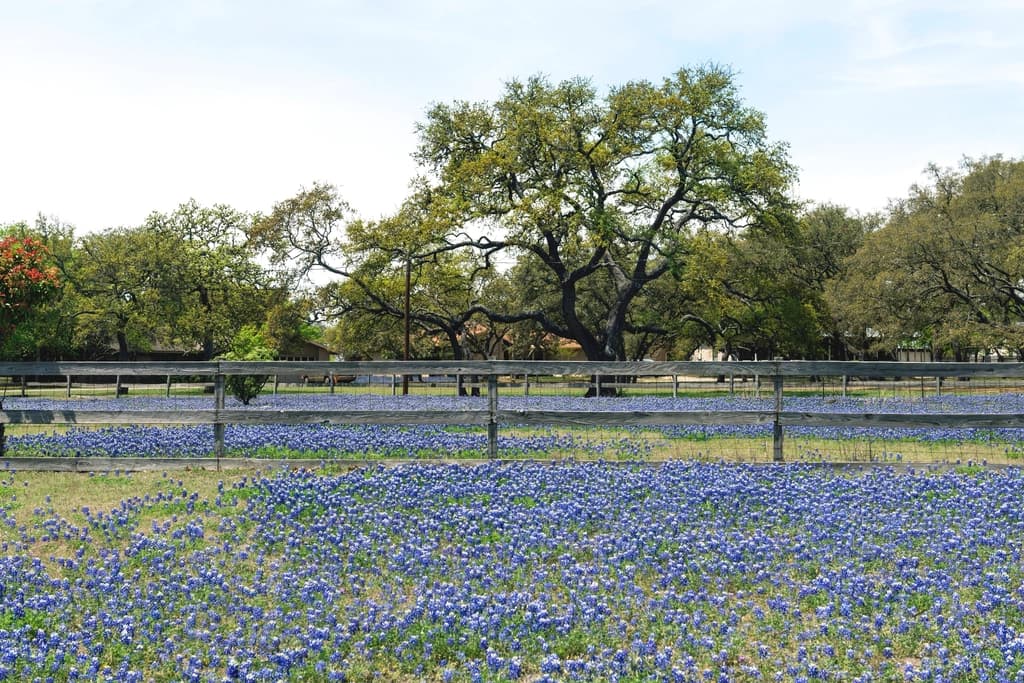
Texas named the bluebonnet in 1901, its first official state symbol of any kind, then found that one species wasn't enough. In 1971 the legislature widened the designation to Lupinus texensis and any other variety of bluebonnet. Our Texas trivia questions ask about it.
Hawaii picked a flower most residents will never see in the wild. The yellow hibiscus, ma'o hau hele, became the state flower in 1988; it grows only in Hawaii and is rare enough to be listed as endangered.
And Indiana changed its mind. The zinnia was the state flower from 1931 to 1957, when the General Assembly swapped it for the peony.
All 50 state flowers, A to Z
Each state's official flower, with the year it was adopted where the records agree. Where they don't, there's another detail instead.
- Alabama: camellia (Camellia japonica), since 1959.
- Alaska: forget-me-not, chosen in 1917 while Alaska was still a territory.
- Arizona: saguaro cactus blossom, the flower of the cactus that only grows in the Sonoran Desert.
- Arkansas: apple blossom, since 1901.
- California: California poppy (Eschscholzia californica), since 1903.
- Colorado: Rocky Mountain columbine, since 1899, and protected by law.
- Connecticut: mountain laurel, since 1907.
- Delaware: peach blossom (Prunus persica).
- Florida: orange blossom, since 1909.
- Georgia: Cherokee rose (Rosa laevigata), since 1916.
- Hawaii: yellow hibiscus, ma'o hau hele (Hibiscus brackenridgei), since 1988.
- Idaho: syringa, or Lewis's mock orange (Philadelphus lewisii), since 1931.
- Illinois: violet, picked by schoolchildren in 1908.
- Indiana: peony, since 1957, after the zinnia.
- Iowa: wild prairie rose, since 1897.
- Kansas: sunflower, since 1903.
- Kentucky: goldenrod, since 1926.
- Louisiana: southern magnolia, since 1900.
- Maine: white pine cone and tassel, since 1895. Not a flower.
- Maryland: black-eyed Susan (Rudbeckia hirta), since 1918.
- Massachusetts: mayflower, or trailing arbutus (Epigaea repens), since 1918.
- Michigan: apple blossom, since 1897.
- Minnesota: pink and white lady's slipper, named in 1902 and made law in 1967.
- Mississippi: southern magnolia, voted for in 1900 and made law in 1952.
- Missouri: hawthorn blossom, since 1923; around 75 hawthorn species grow in the state.
- Montana: bitterroot (Lewisia rediviva), chosen by open ballot in 1894.
- Nebraska: goldenrod, since 1895.
- Nevada: sagebrush (Artemisia tridentata), a shrub rather than a garden flower.
- New Hampshire: purple lilac, since 1919.
- New Jersey: violet (Viola sororia), one of the four violet states.
- New Mexico: yucca flower, adopted on March 14, 1927.
- New York: rose, since 1955.
- North Carolina: flowering dogwood, since 1941.
- North Dakota: wild prairie rose, since 1907.
- Ohio: scarlet carnation (Dianthus caryophyllus).
- Oklahoma: Oklahoma rose, since 2004; mistletoe remains the state floral emblem.
- Oregon: Oregon grape, since 1899.
- Pennsylvania: mountain laurel, since 1933.
- Rhode Island: violet, the third of the four violet states alphabetically.
- South Carolina: yellow jessamine, since 1924.
- South Dakota: pasque flower, since 1903.
- Tennessee: iris, its cultivated state flower since 1933; the passionflower is its wildflower.
- Texas: bluebonnet, since 1901, widened to every bluebonnet species in 1971.
- Utah: sego lily (Calochortus nuttallii), since 1911.
- Vermont: red clover, a farm crop that made the statute book.
- Virginia: American dogwood, since 1918, which is also the state tree.
- Washington: coast rhododendron, the native species by law.
- West Virginia: great rhododendron, since 1903.
- Wisconsin: wood violet, the last of the four violet states alphabetically.
- Wyoming: Indian paintbrush, since 1917.
Test yourself
Most state flower questions come down to the doubles: two goldenrods, two magnolias, two dogwoods, four violets. Our state trivia questions ask a few, the flower trivia round covers the botany, and the state nicknames article explains the other thing every state chose for itself. If you want a single state, the Utah trivia questions and the Massachusetts trivia questions each include the flower, the sego lily and the mayflower.
Maine's pine cone still comes out ahead in one way. It's the only state flower you can leave on a shelf all year without it wilting.